
Willow
Welcome
to
Willow Class
Year 4
Autumn Term
Mrs Hadley and Miss Taylor
Homework, Spellings and Times Tables
Homework
Reading
Children will receive a reading book from school, matched to their reading ability, which they should read every day. When they have read it sufficiently well to understand and comprehend what they have read, they will take the Accelerated Reader quiz in school, which will enable them to see their ongoing reading progress. Please also encourage them to read their own books, comics and magazines at home as well, to develop a love of reading and to experience a range of authors and genres – some of these, they may be able to take a quiz on too!
A visit to a local library can be an amazing experience and enables children to be exposed to an extensive collection of books and resources. Find out more information and details about your local library at the link below.

Spellings
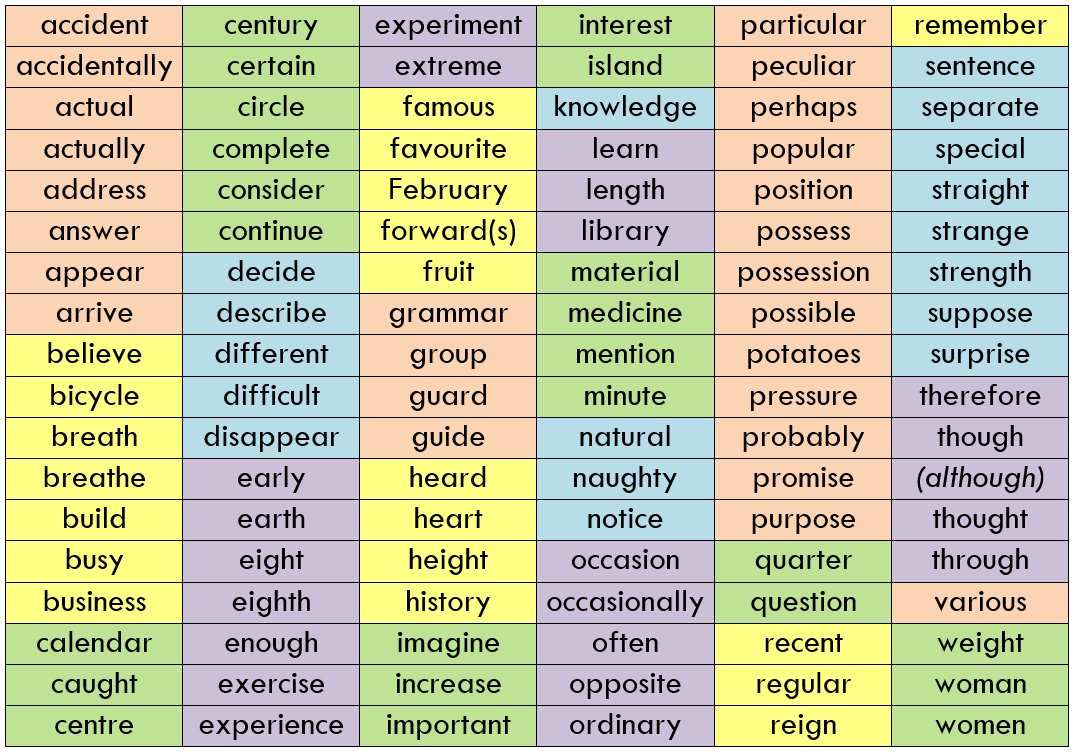
These will be set weekly and practised in school. As well as specific spelling patterns, the Year 3/4 words below will be learnt throughout the year.
We are now using Spelling Shed to support the children's learning; spelling lists and activities can be accessed by logging in. A parents' guide to using Spelling Shed is attached below.
Timetables
Children have been learning their multiplication and division facts since the beginning of Year 2. Children should use their own personalised programme on the online platform, Times Table Rock Stars, every day, to practise these so that they know all of their facts up to 12 x 12 by the end of Year 4.
Homework Projects:
This half-term, our geography topic is all about Anglo Saxons. For our homework project, children can choose from the Anglo Saxon grid below. These projects enable you to be creative in ways that you enjoy. This is a long-term project, to be handed in by Friday 23rd October to be shared with the class, so please ensure the finished work reflects the time and effort expected of a Year 4 project. You can complete more than one project if you wish to.
These projects will be exhibited to parents at the Open Classroom Event, on Monday 14th December, at the end of term.
If you have any questions about any of the above, please ask via Google Classroom.
Summer Term 2 – History Topic
Anglo Saxons
This half term, Willow Class will travel back in time to explore Anglo-Saxon Britain, discovering who the Anglo-Saxons, Picts and Scots were and what life was like during this fascinating period. We will investigate archaeological evidence and artefacts, explore Anglo-Saxon homes, society, culture and beliefs, and discover the story of Beowulf. Throughout the topic, we will develop our skills as historians by questioning evidence and finally solving the mystery of who was buried at Sutton Hoo.
English
This half term in English, Willow Class will be inspired by the epic tale of Beowulf. We will develop our descriptive writing skills by creating vivid character descriptions, using ambitious vocabulary, expanded noun phrases and carefully crafted descriptive sentences. We will also write a diary entry, exploring character thoughts, feelings and experiences while developing our understanding of how writing changes for different audiences and purposes. Throughout the half term, we will focus on planning, drafting, editing and improving our work, learning to make thoughtful choices about vocabulary, sentence structure, punctuation and presentation so that our writing is clear, engaging and effective.
We will also enhance our reading comprehension by exploring a variety of literature, poetry, and non-fiction texts using the VIPERS strategy.
The VIPERS strategy is a structured approach to reading comprehension that supports students in understanding and analysing texts more deeply. Each letter in VIPERS corresponds to a specific reading skill, encouraging a comprehensive approach to text exploration:
V - Vocabulary: Analysing words in the text to understand the meaning of unfamiliar terms in context. Children will explore language choices and their effects, discussing synonyms, antonyms, and how word choices influence tone or mood.
I - Inference: Reading between the lines to derive implicit meanings. Children will practice making educated guesses based on textual clues, context, and prior knowledge, supporting their inferences with evidence from the text.
P - Prediction: Making predictions about what might happen next in the text based on the information read so far. This encourages engagement and critical thinking about plot developments, character motivations, and potential outcomes.
E - Explanation: Discussing and clarifying ideas and themes presented in the text. Children will learn to explain their reasoning and interpretations clearly while using evidence from the text to support their views.
R - Retrieval: Finding and identifying specific information in the text. Children will answer questions that require them to locate facts, details, or events directly stated, improving their capacity to gather pertinent information efficiently.
S - Summarisation: Summarising the main ideas or events of the text. Children will practice distilling information down to its essence, capturing key points and overall themes to ensure they grasp the text's main message effectively.
By applying the VIPERS strategy, we provide a comprehensive framework for children to engage with texts critically and thoughtfully, promoting a deeper understanding of reading materials and enhancing their overall comprehension skills. This method encourages varied approaches to analysing texts, making reading an interactive and reflective process.
This journey will enrich our understanding of different genres while broadening our vocabulary and improving our grasp of grammar and punctuation. We look forward to an exciting and educational half-term!
Remember...

Maths
During this we will investigate:
- Place Value
- Addition and Subtraction
Have a look at the WRM Website (click on the logo below) for resources to support your child with these topics.

Autumn 1 KIRF: I know number bonds to 100
Autumn 2 KIRF: I know the 6 and 9 times table
Spring 1 KIRF: I know the 7 and 11 times table
Spring 2 KIRF: I know all times table facts to 12 x 12
Summer 1 KIRF: I can multiply and divide a single digit by 10 & 100
Summer 2 KIRF: I can recognise simple equivalent fractions
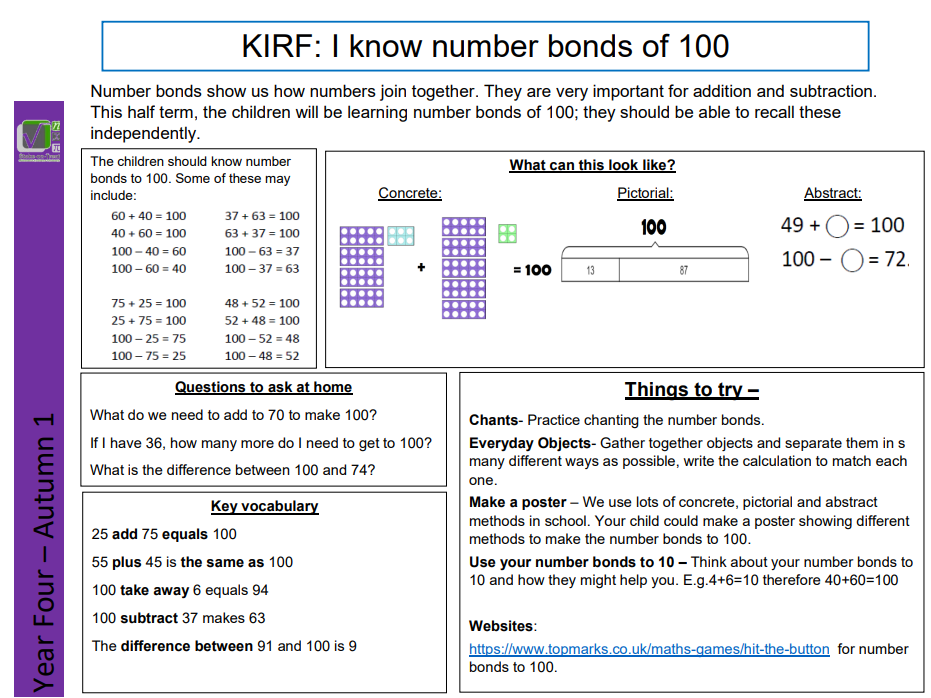
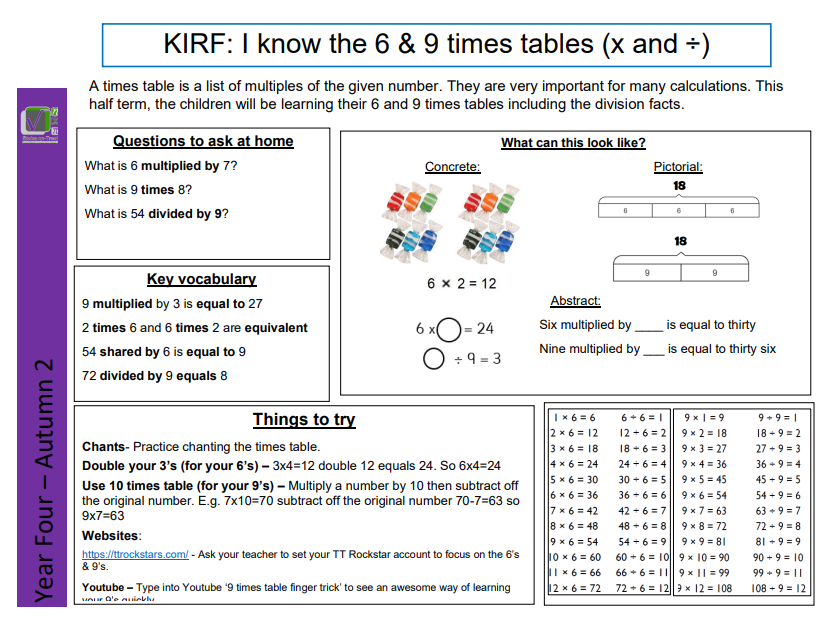
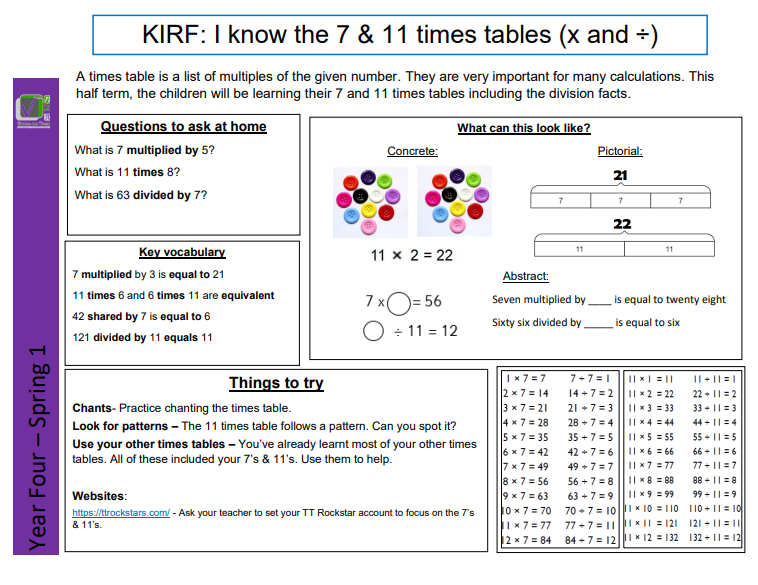
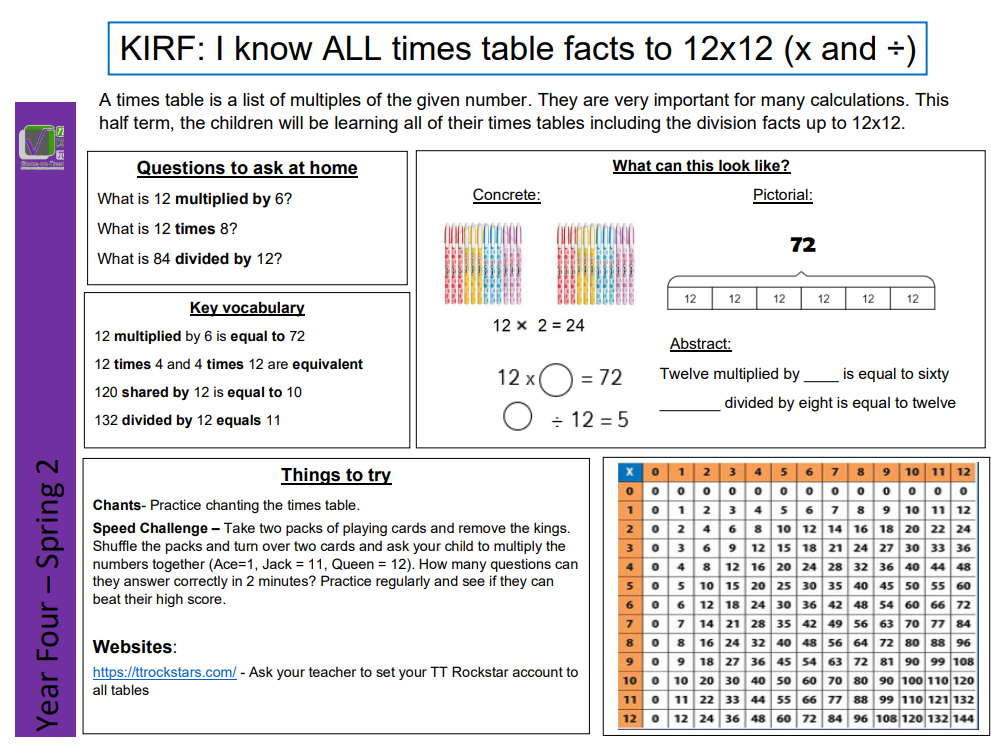
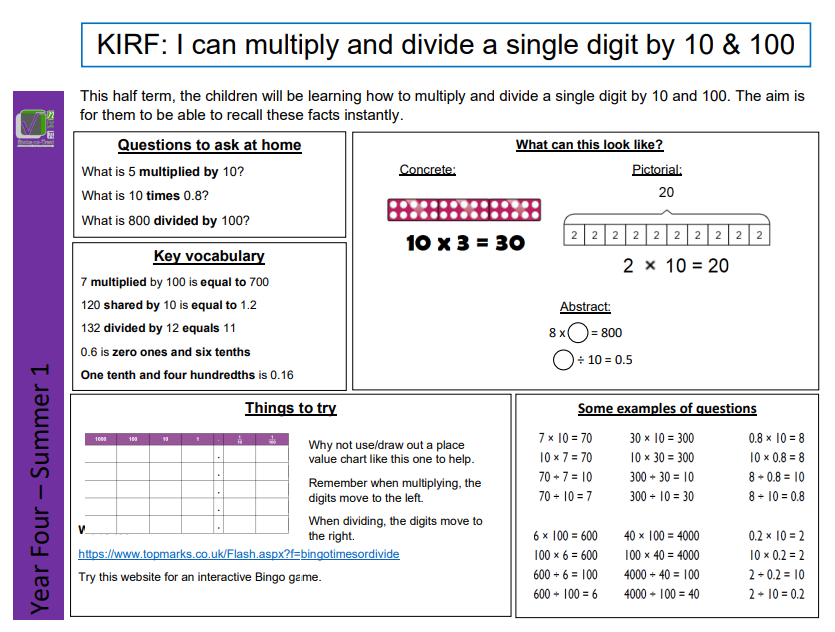
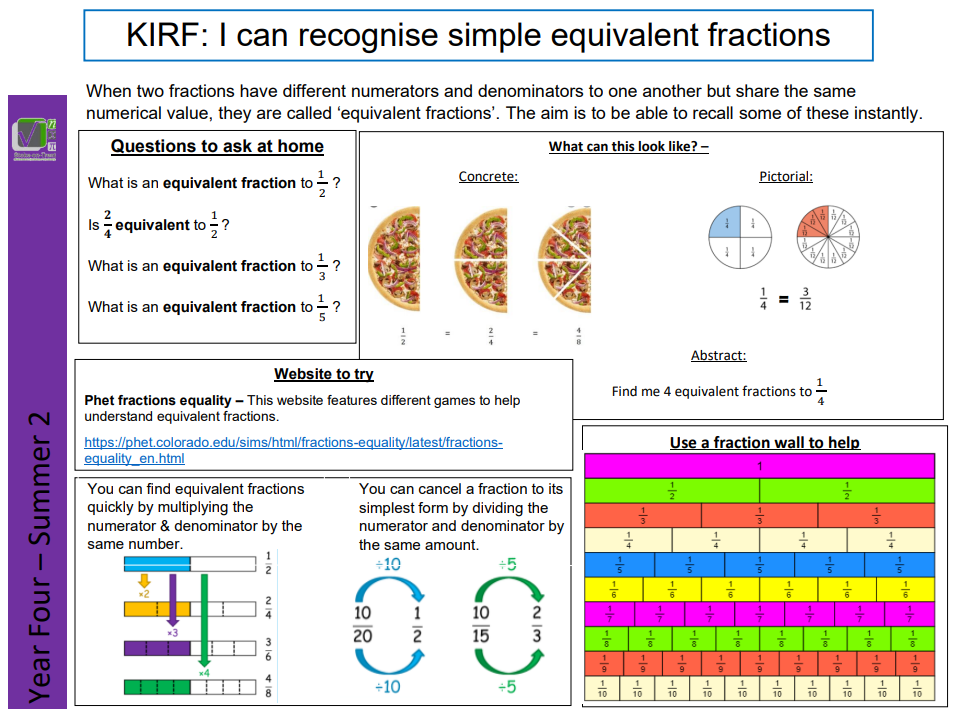
Continue to practise your maths facts – there is a great leaflet below giving you fantastic advice on how to make learning maths fun at home.
Time Tables
Multiplication tables Check
Your child will be participating in the Multiplication Tables Check in June. The purpose of the check is to determine whether your child can fluently recall their timetables up to 12, which is essential for future success in mathematics. It will also help us identify if your child needs additional support.
What is the Multiplication tables check? It is an on-screen check consisting of 25 times table questions. Your child will be able to answer 3 practice questions before taking the actual check. They will then have 6 seconds to answer each question. On average, the check should take no longer than 5 minutes to complete.
What if my child cannot access the check? There are several access arrangements available for the check, which can be used to support pupils with specific needs. Your child’s teacher will ensure that the access arrangements are appropriate for your child before they take the check in June. The check has been designed to be inclusive and accessible to as many children as possible, including those with special educational needs or disability (SEND) or English as an additional language (EAL). However, there may be some circumstances in which it will not be appropriate for a pupil to take the check, even when using suitable access arrangements. If you have any concerns about your child accessing the check, you should discuss this with your child’s school.
Do I need to do anything to prepare my child for the check? No, you do not need to do anything additional to prepare your child for the check. As part of usual practice, we will ask you to practise times table with your child. We will have unlimited access to a 'try it out area' from March. We can use this to make sure pupils have the necessary support required to access the check. This includes opportunities for pupils to familiarise themselves with the check application and try out any access arrangements that may be required.
How will the results be used? We will have access to all our pupils’ results, allowing those pupils who need additional support to be identified.
Will I receive feedback on my child’s check? Yes. Your child’s teacher will share your child’s score with you in the annual school report, as they would with all national curriculum assessments. There is no pass mark for the check.
Taken from: Information for parents: 2025 multiplication tables check (see below)
Science
Living Things and their Habitats
This half-term in Science, Willow Class will explore Living in Environments. We will investigate a variety of habitats and discover how the conditions within them help different organisms to survive. We will learn how to group and classify animals using their characteristics and classification keys, as well as identifying and classifying a range of British plants. We will also explore how human activity can affect habitats and consider ways that we can help to protect and sustain our local environments.
Computing
Animation
This half term in Computing, Willow Class will explore Animation, learning how animators bring images to life and discovering a range of traditional and digital animation techniques. We will experiment with onion skinning, plan our own animations and use animation software to create engaging 2D animations that tell a story. We will also develop our ability to evaluate and improve our work, thinking carefully about how effective our animations are.
Most of the classwork will be done using Purple Mash. Log on below to complete any tasks set or to just explore and have some fun!
PE/LOTC
This term in PE we will be taking part in:
- Hockey
- Fundamentals
- Tag Rugby
- Dance
This term, we will usually do PE on a Wednesday and Thursday, but please ensure your indoor and outdoor PE kit is in school at all times, just in case this has to change.
In LOTC we will be doing:
- Reinforcing outdoor rules and expectations
- Fire safety and environmental awareness
- Tidy up routines and expectations
- Art with natural materials
- Outdoor cooking
|
|
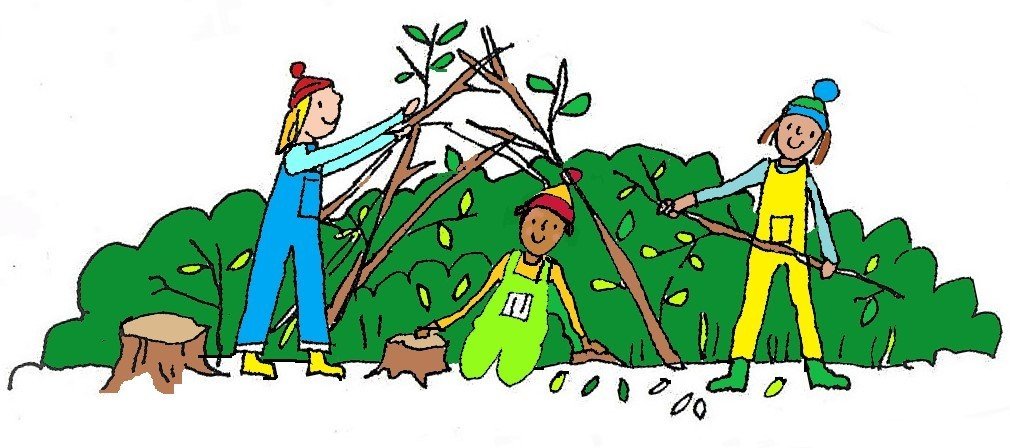
LOTC is on Mondays – please ensure you are wearing and have suitable clothing (arms and legs to be covered at all times) for the activities and weather conditions. A hat and sun cream in hot weather is needed and a warm hat, scarf and gloves for cold weather. It is always a good idea to bring a spare set of clothes to c hange into after your outdoor session – just in case!